Overview: Cho Oyu Expedition—8,201 m
Overview
Cho Oyu, rising to a commanding 8,188 meters (26,864 ft) above sea level, is the sixth-highest mountain in the world and one of the most approachable 8,000-meter peaks. Straddling the Nepal–Tibet border just west of Everest, Cho Oyu is part of the towering Mahalangur Himalaya. Its name means “Turquoise Goddess” in Tibetan—a reference to the shimmering hues that grace its icy flanks during sunset.
For climbers looking to step into the realm of high-altitude mountaineering, Cho Oyu offers the perfect opportunity. It is often considered the “easiest” of the 8,000ers due to its moderate technical difficulty, relatively stable weather patterns, and high success rate. However, at such altitudes, no climb is ever easy, and success on Cho Oyu demands solid preparation, acclimatization, mental resilience, and teamwork.
At The Himalayan Realms Treks and Expedition Nepal Pvt. Ltd., we offer a professionally guided Cho Oyu expedition that focuses on safety, logistics, acclimatization, and cultural immersion. Our seasoned Sherpa guides, high-altitude climbing support, and experienced leadership make this journey not only attainable but deeply fulfilling.
Key Highlights
-
Summit the sixth-highest mountain on Earth—8,188 m (26,864 ft)
-
Ideal first 8,000-meter peak for experienced mountaineers
-
Climb from the Tibetan side, with well-established routes
-
Cultural exploration in Lhasa and Tibetan Plateau
-
Full support from experienced Sherpa and expedition team
-
Incredible views of Everest, Lhotse, Makalu, and Shishapangma
The Route & Climbing Strategy
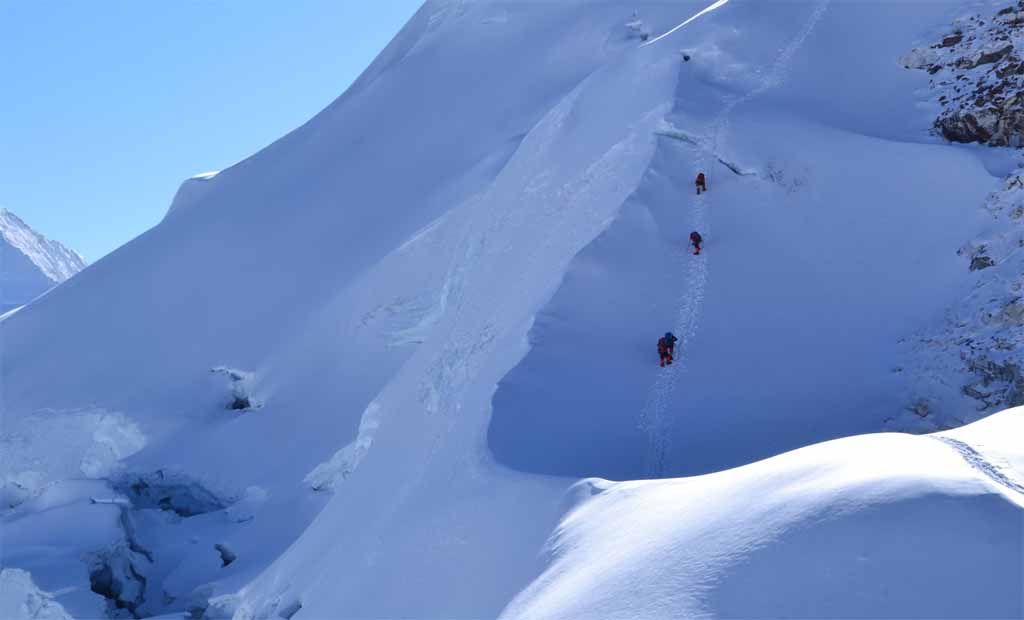
Our Cho Oyu expedition approaches the mountain from the Tibetan (Northwest) side, via the traditional and most frequented route. This route is favored for its relatively non-technical terrain, lack of major objective dangers (such as seracs or avalanche-prone faces), and logical progression of camps.
Base Camp to Summit Overview:
-
Base Camp (5,000 m)—Located near the roadhead after driving from Tingri, it’s the initial staging area.
-
Advanced Base Camp (ABC)—5,700 m— Situated at the base of the Northwest Face, ABC serves as the expedition’s operational hub.
-
Camp I (6,400 m)—Reached via a scree slope and glaciated route, it’s the first major acclimatization milestone.
-
Camp II (7,000 m)—Positioned on a broad snowfield. This camp prepares climbers for summit rotation.
-
Camp III (7,450 m)—High camp on a protected slope below the Yellow Band. From here, the summit push begins.
-
Summit (8,188 m)—The final section includes a steep snow face and the famed summit plateau, offering panoramic views of the Himalayas.
While ropes are fixed on steeper sections, the route itself does not demand advanced ice climbing or mixed climbing experience. However, the thin air, crevasses, and prolonged exposure to cold require physical fitness, mental endurance, and altitude adaptability.
Expedition Itinerary 40-days (Sample)
This is a sample outline. Days may shift slightly due to weather, health, or local conditions.
Kathmandu & Tibet Phase
-
Day 01–03: Arrive in Kathmandu, expedition briefing, equipment check, visa preparation
-
Day 04–05: Drive to Kerung (via Rasuwa), acclimatize
-
Day 06–08: Drive to Tingri via Saga, rest, and acclimatization
-
Day 09–10: Drive to Chinese Base Camp (5,000 m)
Approach & Acclimatization Phase
-
Day 11–14: Trek to Interim Camp and then to Advanced Base Camp (5,700 m)
-
Day 15–20: Acclimatization hikes, technical training, gear organization
Climbing Period
-
Day 21–36: Multiple rotations between ABC, Camp I, Camp II, and Camp III
-
Summit Push: Weather window dependent, typically between Day 30–35
-
Day 37: Clean-up and descent to Base Camp
-
Day 38–39: Return drive to Kathmandu
-
Day 40: Final celebration and departure
Physical & Technical Requirements
Although considered one of the least technically demanding 8,000-meter peaks, Cho Oyu is still a major Himalayan climb. Success requires:
-
Prior high-altitude experience (e.g., 6,000 m to 7,000 m peaks like Island Peak, Mera Peak, or Aconcagua)
-
Solid fitness level: endurance for 6–8 hours of climbing per day at altitude
-
Familiarity with crampons, fixed rope systems, and using an ascender (Jumar)
-
Mental resilience to face extreme weather, fatigue, and isolation
Our team provides pre-expedition consultations, training plans, and gear advice to help you prepare effectively.
Cultural and Environmental Aspects
The journey to Cho Oyu includes cultural immersion in both Nepal and Tibet. Beginning in Kathmandu, climbers explore ancient Hindu and Buddhist temples and the vibrant lifestyle of the Kathmandu Valley.
As we travel into Tibet via the Kerung border, the landscape changes dramatically. The Tibetan plateau stretches into stark beauty, dotted with remote monasteries, prayer flags, and yaks grazing under enormous skies. Lhasa is often included in the return route for those who wish to explore the iconic Potala Palace and Jokhang Temple.
Environmental responsibility is central to our approach. We follow the “Leave No Trace” principle, ensure proper waste disposal, and minimize ecological impact at all camps.
Why Climb Cho Oyu with Himalayan Realms Treks?
At The Himalayan Realms Treks and Expedition Nepal Pvt. Ltd., we provide more than just logistics—we offer an experience rooted in trust, excellence, and deep Himalayan knowledge. Here’s what sets us apart:
1. Veteran Leadership
Our mountaineering team includes highly experienced leaders, many of whom have summited multiple 8,000-meter peaks, including Everest, Lhotse, and Manaslu. Their leadership ensures sound decision-making and high safety standards.
2. World-Class Sherpa Support
Sherpas are the heart of any successful Himalayan expedition. Our team of certified and seasoned Sherpas brings unparalleled local knowledge, skill, and dedication to every step of the journey.
3. Comprehensive Logistics
From transportation and permits to food, oxygen, and high-altitude tents, we manage all logistics with precision. Our base camp service includes fresh meals, internet access (where possible), and medical support.
4. Safety and Success
We use a 1:2 Sherpa-to-client ratio for maximum support. Medical oxygen, pulse oximeters, satellite communications, and a dedicated expedition doctor ensure preparedness for emergencies.
5. Personalized Service
Unlike large commercial operators, we keep our groups small and focused. This allows us to provide personalized guidance, tailor acclimatization, and maintain team cohesion.
Weather & Best Season
The ideal window for climbing Cho Oyu is the pre-monsoon (April–May) and post-monsoon (September–October) seasons. Among these, the autumn window (Sept–Oct) is generally preferred due to more stable weather and less precipitation on the Tibetan plateau.
Daytime temperatures can range between -10°C and -25°C at high camps, and summit-day temperatures may drop to -30°C or lower. Wind chill is a constant challenge. Our itinerary incorporates adequate rest and acclimatization days to minimize altitude risks.
Equipment and Gear
Each climber must bring appropriate high-altitude gear, including
-
8000-meter double boots (e.g., La Sportiva Olympus Mons)
-
Down suit (-40°C rated)
-
Crampons, harness, helmet, ice axe
-
Sleeping bag (rated to -40°C), expedition backpack
-
Personal first aid and high-altitude medications
-
Sunglasses, goggles, gloves, and balaclava
We provide all group gear (tents, fixed rope, oxygen, etc.), and a detailed packing list is shared upon booking.
Cost & Inclusions
Cho Oyu expeditions typically cost between USD 18,000 to 24,000, depending on group size, route options, and customization. Our package includes:
Inclusions:
-
All ground transportation in Nepal and Tibet
-
Tibet entry permits, visas, and all climbing permits
-
Kathmandu hotel accommodation with breakfast
-
All meals during the expedition
-
Professional Sherpa guides and high-altitude staff
-
Base Camp services, tents, and kitchen
-
Oxygen cylinders and mask system
-
High-altitude food and gear transport
-
Satellite phone and communication equipment
-
Medical and emergency supplies
-
Group climbing equipment and logistics
Exclusions:
-
International airfare
-
Personal climbing gear
-
Insurance (travel, evacuation, medical)
-
Tips and gratuities
-
Alcohol, beverages, and personal expenses
Conclusion
Climbing Cho Oyu is a dream realized for many mountaineers—a powerful blend of physical achievement, spiritual discovery, and raw Himalayan grandeur. It stands as a gateway to the world of 8,000-meter peaks, offering the ideal balance between challenge and accessibility.
Whether you aim to test your limits, train for Everest, or immerse yourself in the magic of the Tibetan Himalayas, the Cho Oyu Expedition delivers a life-defining adventure. With The Himalayan Realms Treks and Expedition Nepal Pvt. Ltd., you’re not just climbing a mountain—you’re becoming part of a legacy forged in ice, faith, and perseverance.
Join us. The Turquoise Goddess awaits.
Day 01: Kathmandu to syabrubeshi by tourist bus, about 8 hrs. The scenic drive from Kathmandu to Syabrubesi (about 8 hours) offers a rich blend of natural beauty and cultural glimpses. Leaving the busy city behind, the road winds through green hills and terraced farmland. As you ascend past Kakani, you can catch distant views of Ganesh Himal and Langtang Lirung on a clear day. The Trishuli River accompanies much of the journey, adding a serene backdrop. Around Ranipauwa and Trishuli Bazaar, local villages, colorful prayer flags, and traditional houses provide insight into rural life. The road narrows and climbs sharply after Dhunche, revealing stunning panoramas of snowcapped peaks, deep gorges, and pine forests. From Dhunche, you may spot Langtang Ri, Langtang Lirung, and even glimpses of Tibetan ranges in the north. This drive is more than a transfer—it’s an introduction to the Himalayan landscape and the cultural richness of the Langtang region.
Day 02: Syabrubeshi, 2,470 meters (8,104 feet), to Lama Hotel, 1,460 meters (4,790 feet), about 7 hrs:
The trek from Lama Hotel (2,470 m / 8,104 ft) to Mundu (3,550 m / 11,647 ft) takes around 6 to 7 hours, with a steady ascent through lush alpine terrain and into open glacial valleys.
The trail continues along the Langtang Khola, climbing through dense forests of rhododendron, oak, and pine. You pass the landslide area and gradually approach Ghodatabela, where the forest thins and the first views of Langtang Lirung (7,227 m) appear. This is a good place to rest and enjoy the mountain scenery.
From here, the valley widens, offering more sunlight and spectacular views. Passing through Thyangsyap and then the ruins of old Langtang village, which was destroyed in the 2015 earthquake, you eventually reach Mundu, a small but charming settlement just above the valley floor. The views from Mundu are breathtaking, with surrounding snow-capped peaks and prayer flags fluttering in the mountain wind.
Day 03: Lama Hotel (2,470 m / 8,104 ft) to Mundu (3,550 m / 11,647 ft):
The trek from Lama Hotel (2,470 m / 8,104 ft) to Mundu (3,550 m / 11,647 ft) is a scenic and rewarding journey that takes about 6 to 7 hours. The trail steadily ascends through dense forests of rhododendron, pine, and oak, following the Langtang Khola. As you gain elevation, the vegetation becomes sparser, giving way to alpine shrubs and open meadows.
You pass through key points like Ghodatabela (3,030 m), where the landscape opens up and you get the first clear views of Langtang Lirung (7,227 m). After a short rest, the trail continues through Thyangsyap and past the site of the old Langtang village, a somber reminder of the 2015 earthquake.
Finally, you reach Mundu, a peaceful settlement with stone houses, fluttering prayer flags, and panoramic mountain views. The climb brings a noticeable change in temperature and altitude, so it’s important to pace yourself and stay hydrated
Day 04: Mundu (3,550 m / 11,647 ft) to kyanjingumpa: 3,870 meters (12,697 feet): The trek from Mundu to Kyanjin Gompa begins early in the morning, typically around 7:30 AM. The trail ascends gradually along the Langtang Khola, gaining approximately 320 meters (1,050 feet) in elevation. The journey takes around 3–4 hours, offering outstanding views of Langtang Lirung (7,227 m), Kimshung, and Yansa Tsenji peaks. As you move higher, the valley opens into expansive yak pastures dotted with chortens, mani walls, and fluttering prayer flags.
On the way, trekkers pass through small settlements like Sindum and Yamphu, where traditional stone houses and terraced fields reflect rich Tamang culture. Colorful rhododendrons and alpine vegetation add vibrancy to the landscape in spring. Reaching Kyanjin Gompa, you’re welcomed by a serene village surrounded by towering snow peaks. The famous Kyanjin Monastery and nearby cheese factory showcase the cultural and economic richness of this high-altitude community nestled deep in the Langtang Valley.